SURVIVAL
Immediate stabilization
Resource connection • Financial assessment • Goal development • Immediate barrier reduction
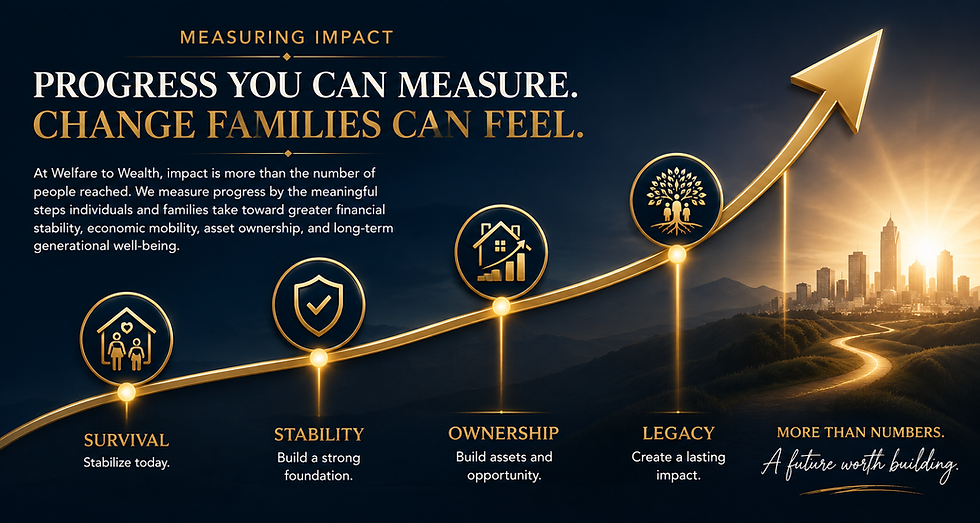
At Welfare to Wealth, impact will be measured by more than the number of people reached. We are building an outcomes-focused approach that tracks meaningful progress from immediate stability toward economic mobility, ownership, and long-term financial well-being.
Measuring Progress Across The Pathway
Rather than defining success by a single outcome, we will track meaningful indicators across each stage of the pathway—helping us understand not only who we serve, but whether families are making measurable progress toward greater economic mobility.
Progress You Can Measure.
Change Families Can Feel.
STABILITY
Household financial security
Budgeting • Emergency savings
• Income growth • Employment advancement • Debt reduction
MEASURING IMPACT
OWNERSHIP
Asset-building progress
Credit improvement • Savings growth • Homeownership readiness • Investing • Entrepreneurship
LEGACY
Long-term economic mobility
Asset ownership • Wealth-building behaviors • Intergenerational financial knowledge • Leadership & community engagement
From Participation to Progress
Across our programs and initiatives, we will evaluate progress in six interconnected areas that reflect a family's movement toward greater economic security and opportunity.
Financial Stability
01
Budget development • Emergency savings
• Debt reduction • Financial confidence
.png)
Income & Employment
02
Employment status • Income growth • Career advancement • Skill development
Financial Capability
03
Financial knowledge • Money-management behaviors • Goal completion • Credit readiness
Housing & Ownership
04
Housing stability • Homeownership readiness • Down-payment preparation • Asset acquisition
Wealth Building
05
Savings growth • Investing participation
• Multiple income streams • Long-term financial planning
Family & Community Impact
06
Intergenerational financial education • Leadership development • Mentorship • Community engagement
A Data-Informed Approach to Impact
Evaluation is being built into the participant experience from the beginning. By collecting information at key points along the journey, we can identify progress, understand barriers, strengthen program delivery, and continuously improve how we serve families.
Where did the participant begin?
01 - BASELINE
What services and resources did they engage with?
02 - PARTICIPATION
What changed along the way?
03 - PROGRESS
What measurable milestones were achieved?
04 - OUTCOMES
Was progress sustained over time?
05 - FOLLOW-UP
Tools may include: participant assessments • surveys • goal trackers • financial progress measures
• program participation records • milestone tracking • follow-up assessments
HOUSEHOLDS SERVED
Program Reach
The Metrics That Matter
The Outcomes We Plan to Track
% INCREASING SAVINGS
Financial Resilience
Baseline data collection and outcome tracking will begin with program implementation.
As programs are implemented, Welfare To Wealth will establish baseline data and track key indicators of participant progress across financial stability, income growth, ownership, and long-term wealth building.
% INCREASING INCOME
Economic Advancement
% REDUCING DEBT
Financial Stability
ADVANCING TOWARDS OWNERSHIP
Ownership & Asset Readiness
ACHIEVING FINANCIAL MILESTONES
Individual Progress
Behind Every Goal Is a Family Building A Different Future

Behind every metric is a family working toward something meaningful—a more stable household, greater earning potential, preparation for ownership, and a stronger financial foundation for the next generation.
That is the progress Welfare To Wealth is being built to support: change that can be measured over time and carried forward across generations.
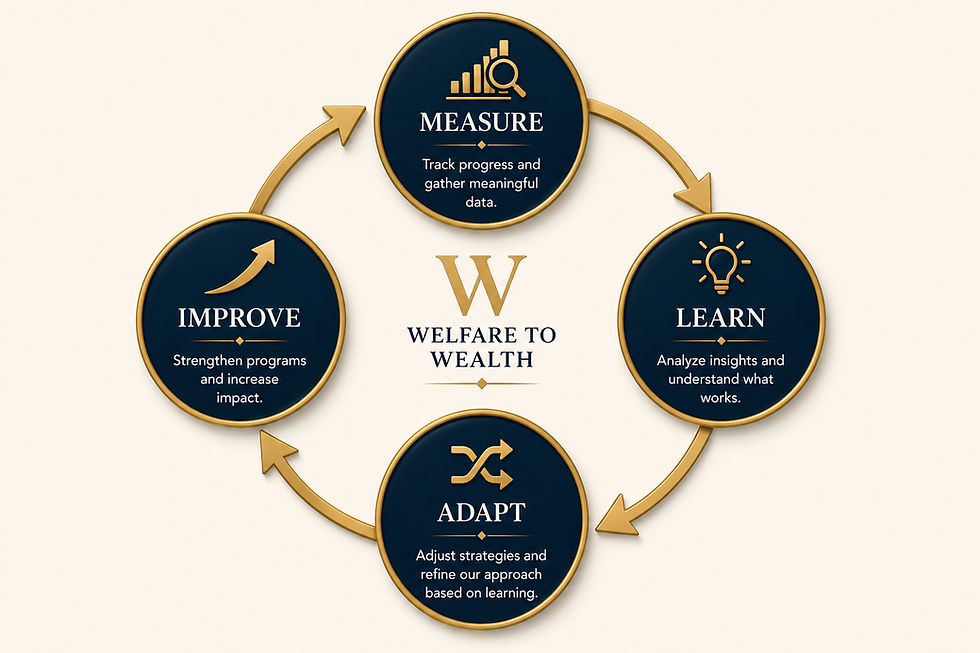
Measure. Learn. Adapt. Improve.
Measurement is only valuable when it leads to action. As our programs grow, participant feedback and outcome data will help us identify what is working, address gaps, strengthen our initiatives, and communicate results responsibly.
What we learn will inform how programs are adapted and improved over time.